18 players per side
Each team fields 18 players on the oval. From 2026, clubs can name five interchange players, making 23 selected players total.
 Tampa BayTiger Sharks
Learn the game
Australian rules football is fast, physical, and played in every direction. The aim is wonderfully uncomplicated: score more points than the opposition.
You don't need experience—just bring boots, water and curiosity. Whether you're watching or playing, here's what you need to know.
The basics
Each team fields 18 players on the oval. From 2026, clubs can name five interchange players, making 23 selected players total.
Each quarter is 20 minutes of actual playing time. Time is added for stoppages and injury assessment.
Players may kick or handball the ball. Throwing is illegal. When running, players must bounce or touch the ball on the ground at least once every 15 metres.
The team with the most total points when the match ends wins. It's that simple.


The rules of play
Catching an untouched kick that has travelled at least 15 metres earns a mark. The player may then stop and take an unimpeded kick.
A player possessing the ball may be tackled between the shoulders and knees. High tackles, trips, pushes in the back and dangerous tackles are prohibited.
A player who had a reasonable opportunity to dispose of the ball must immediately kick or handball when legally tackled. Without prior opportunity, they must make a genuine attempt.
Players can generally move anywhere on the ground. There is no offside rule in Australian rules football.
A kick that goes out on the full normally gives the opposition a free kick. Other boundary situations may produce a throw-in or free kick depending on where and how the ball went out.
Free kicks are awarded for infringements including high contact, holding, pushing in the back, incorrect disposal, prohibited blocking and deliberate or regulated boundary violations.
May be imposed for delaying play, entering the protected area, failing to stand the mark correctly or abusing/disobeying an umpire.
Play begins and restarts after goals with an umpire's centre throw-up. After a behind, the defending team kicks the ball back into play.
Scoring points
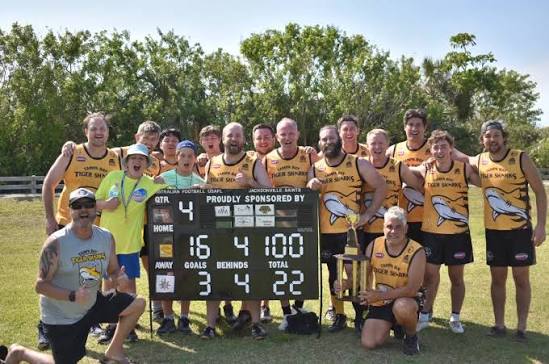
Scores are written as goals.behinds (total). For example, 10.8 (68) means 10 goals and 8 behinds: (10 × 6) + 8 = 68 points.
The culture
The football.
A spectacular high mark, usually taken while standing on another player's shoulders.
Another name for a huge aerial mark.
A goal. Apparently every good thing must sound like barbecue food.
A goal.
The goalposts.
The dangerous, direct route through the middle of the field.
Getting the ball into the attacking 50-metre arc.
A spectacularly obvious mistake.
Swinging a boot and completely missing the ball.
Faking one way and dodging the opponent the other.
Becoming fiercely competitive the moment a player crosses onto the field.
Shouted whenever anyone is tackled, regardless of whether holding the ball should actually be paid.
The player has allegedly run too far without bouncing.
A classic umpire critique.
Demanding a mark after a kick travelled roughly seven metres.
A plea for action.
Encouragement to kick a goal.
The traditional conclusion to every close loss.
"He's sold the candy, gone straight through the guts and dobbed a sausage roll from fifty! Absolute scenes—the lid is officially off."
Translation: the player dodged an opponent, ran through the centre and kicked a long goal. Everyone is now behaving irrationally.